
Window AC Mold: How to Clean It and When to Replace
· Daniel Morcombe
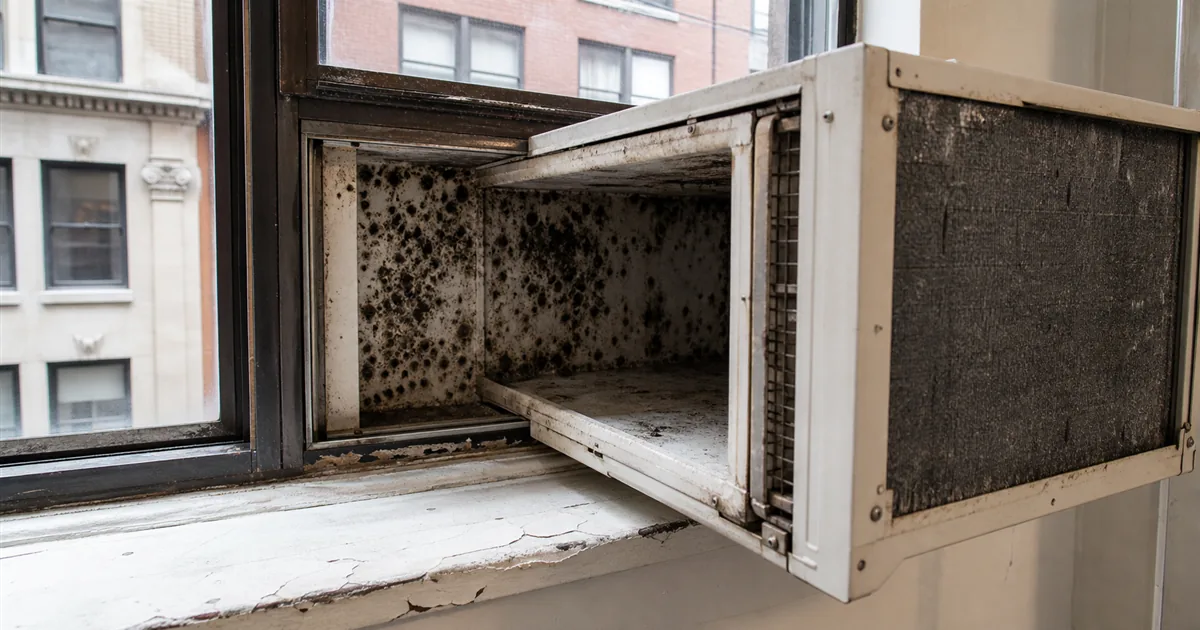
Mold in a window AC shows as black speckling and a musty smell when it runs. Learn how to clean a unit safely and when to replace it.
If you see black speckling on the vents of a window or wall AC unit, and if you get a musty smell when it runs, that’s mold. Light surface growth is cleanable, but if foam or interior material is saturated, the unit generally needs to be replaced. Clean the unit or replace it before reuse.
How to Tell Your AC Has Mold
Check the front grille, the louvers, the washable filter and other areas that the manufacturer allows you access to for new speckling. Another good clue is a musty smell that begins when the unit runs. Mold can be different colors so appearance alone does not identify a species. Dust can also look like growth.
Turn it off and then check. Note a damp filter, pooled water, or smell after normal filter cleaning. Photograph areas that are free and clear, but do not open electrical or sealed components. According to the CDC mold overview, if you see mold or smell mold, you need to fix the moisture problem and clean up the mold, not identify the mold name.
How to Clean a Window AC Unit Safely
Cleaning is possible only if the growth is light and limited to accessible hard or washable surfaces and the unit can be thoroughly dried. Use the manual for your exact model because covers, filters, and drainage differ.
- Disconnect the unit. Do not work on energized parts.
- If you move it, get help. Window units are heavy and can fall down.
- Remove the washable filter and the front cover as described in the manual.
- Wash approved parts with detergent and water. Wear gloves and goggles, ventilate and avoid mixing cleaning products.
- Don’t bend coils or push material further inside. Clear debris from the drain path.
- Let each cleaned part dry thoroughly before reassembly.
- Replace disposable filters with the manufacturer-specified type, then watch for returning odor or moisture.
When to Replace the Unit Instead
If a foam filter, insulation or other porous interior part is saturated or visibly affected, replacement is the safer practical choice. Similarly if growth continues behind inaccessible panels, the drain system is compromised, corrosion prevents reliable cleaning or a musty odor returns after proper cleaning and drying.
Do not disassemble refrigerant, wiring, fan or sealed cabinet components for a do-it-yourself mold cleanup. Can the unit be opened and repaired without damaging it ? Ask a qualified appliance or HVAC technician . Compare that to replacement, especially on an older unit. Another story is a central or ducted system, see our HVAC mold remediation guide for complete system inspection and containment.
| Unit condition | Recommended action |
|---|---|
| Light growth on accessible washable surfaces | Clean, if the unit can be dried thoroughly |
| Foam filter or insulation saturated | Replace |
| Growth continues behind inaccessible panels | Replace |
| Drain system compromised | Replace |
| Corrosion prevents reliable cleaning | Replace |
| Musty odor returns after proper cleaning and drying | Replace |
Why Window Units Grow Mold in NYC Summers
An air conditioner removes moisture from room air as it passes over a cold coil. Water should flow into a pan and then drain outside. Dirt and standing water on a filter, grille, foam lining or blocked drain area can support growth.
The EPA mold guide specifically recommends keeping air-conditioning drip pans clean and drain lines clear. It also makes the broader point that moisture control is the key to mold control. If the odor is strongest at the wall and not the unit, inspect for leakage or condensation in the sleeve, window frame and adjacent wall. Our musty smell guide will walk you through a process of how to track a smell back to its source.
Preventing Mold After Cleaning or Replacement
Start with drainage . Install the unit in accordance with its manual and keep the exterior drain openings clear. Do not drill a drain hole unless the manufacturer specifies to do so. During the cooling season, check the filter and follow the model's cleaning or replacement schedule.
Store for the season. Dry accessible washable parts. Keep the unit clean and dry. Avoid dust and water. The CDC recommends keeping the indoor humidity level at or below 50 percent. Even with the AC running, the room might still be humid, and a hygrometer will show that. Installation repair may be needed, not just more surface cleaning, if there's condensation around the window or sleeve. See our NYC apartment mold prevention guide for room-level moisture control.
Frequently Asked Questions
Why does my AC smell musty?
A musty odor usually indicates that moisture and organic debris are providing a medium for growth on the filter, drain area, grille or an interior surface. The smell can also be due to the wall or window opening where the unit is located. Switch it off, look at all the accessible parts, and follow the smell to where it is strongest.
Is AC mold dangerous?
People can get stuffy nose, sore throat, coughing, wheezing, burning eyes, or skin irritation from mold. Reactions vary. Stop running a visibly contaminated or strongly musty unit, avoid disturbing growth, and ask a doctor about personal symptoms or medical risk.
Can I clean it myself?
If manual allows and you can safely unplug, handle and dry unit, you can clean light growth from accessible washable parts. Do not open any sealed electrical or refrigerant components. If porous parts are saturated, heavily contaminated, or if odors recur, they should be professionally evaluated or replaced.
When should I replace the unit?
Replace if it is saturated with porous foam or insulation. If contamination cannot be accessed. If damage prevents complete drainage. If odor returns after correct cleaning and drying. A qualified technician can assess if the unit is still serviceable, but if the internal materials can’t be restored, replacement might be more reliable.
How do I stop it coming back?
Keep the filter and accessible drip area clean and be sure the unit drains as its manufacturer intended and dry before storage. Correct water entry around the window or wall sleeve. Rather than repeatedly wiping away the visible surface, check indoor humidity and look for condensation that keeps coming back.