
How to Judge a Mold Removal Company in NYC
· NYC Mold Removal Services
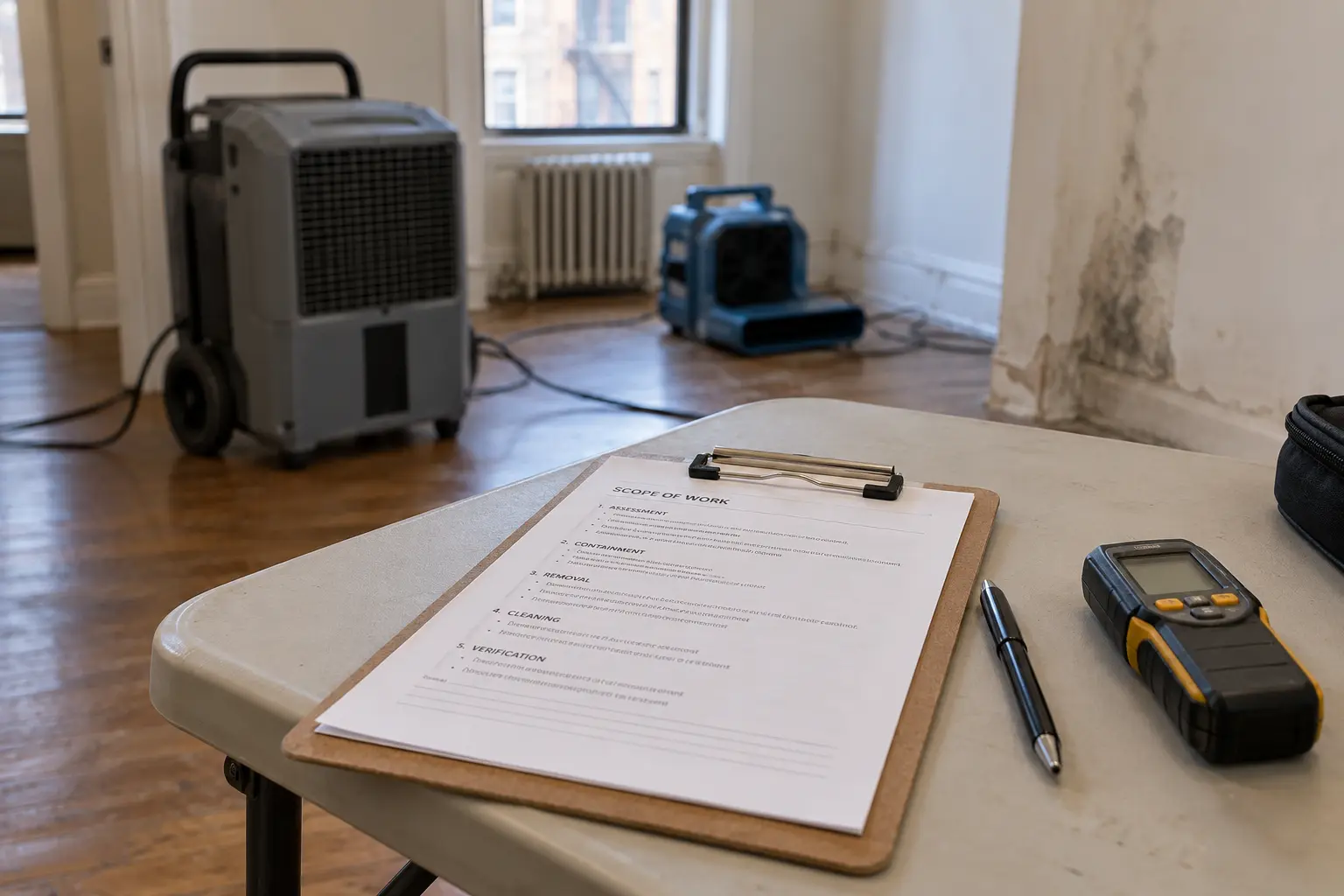
The licence checks, contract terms, and red flags that separate a legitimate NYC mold remediation company from an expensive problem.
There is no objective "best" mold removal company, and any page claiming to rank them is selling placement. What does exist is a set of checks that reliably separates a company operating legally and competently from one that is not. All of them can be done before you sign anything.
Start With the Licence, Because It Is Binary
New York State licenses mold work under Article 32. There are two distinct licence types and a company needs the right one for the role it is playing:
- Mold Assessor, inspects, samples, writes the remediation protocol, performs clearance.
- Mold Remediation Contractor, performs the removal, working to the assessor's protocol.
On any job over 10 square feet, these must be two independent companies. A single company offering to both diagnose and remove a large job is describing an arrangement New York does not permit.
Licences are verifiable through the New York State Department of Labor's mold program. Ask for the licence number, check it, and confirm it is current. A company that hesitates at this request has answered the question.
The Checks, in Order of How Much They Tell You
| Check | What a good answer looks like | What it rules out |
|---|---|---|
| Article 32 licence number | Supplied immediately, verifies as current | Unlicensed operators |
| Separate assessor named | A different company, named up front | The diagnose-and-remove conflict |
| General liability + workers' comp certificates | Current certificates, named insured matches the contract | Uninsured crews in your building |
| Written scope tied to a protocol | Line items that map to the assessor's document | Vague "mold treatment" pricing |
| Containment and negative air described | Specific barriers, HEPA units, pressure differential | Spreading the problem through the apartment |
| Clearance arrangement | Independent assessor, before reconstruction | Self-certified work |
| Building requirements handled | COIs for the managing agent, elevator protection | A crew turned away at the door |
Red Flags Worth Walking Away From
A free "inspection" that is really a sales visit. A visual estimate for removal work is a quote, not an assessment, and it carries no licensed finding. That is legitimate as long as it is described accurately. It becomes a problem when it is sold as an inspection and then used to justify a scope.
Pricing without a measured area. Article 32 scope is area-driven. A price given before anyone has measured the affected area is a number pulled from the air.
Pressure on the same visit. Mold is not a same-hour decision in the overwhelming majority of cases. Urgency applied in the living room is a sales technique.
No mention of the moisture source. Removal without correcting the water is a repeat job. Any company that never asks where the water is coming from is quoting you for a temporary result.
Refusal to work to someone else's protocol. On a job over 10 square feet, the protocol is the assessor's. A contractor who wants to write their own scope for a large job is proposing the arrangement the licensing rule exists to prevent.
What Should Be in the Contract
The written agreement should name the affected areas and their measured size, the containment method, the materials being removed versus cleaned, the HEPA and negative-air equipment in use, who is responsible for the plumbing or roofing repair that stops the water, who performs clearance, what happens if clearance fails, and how change orders are priced. Our guide to the NYC mold remediation contract covers each of those clauses.
Clearance failure is the clause people skip and later regret. If the independent assessor's post-remediation test does not pass, the contract should state plainly whether the return visit is at the contractor's cost.
Reading Reviews Usefully
Volume of five-star reviews is weak evidence. What is worth reading for: whether reviewers mention a written scope, whether anyone describes a clearance test, whether the company is named consistently, and whether negative reviews cluster around change orders or around work that had to be redone. A review that says "fast and friendly" tells you about the visit. A review that says the clearance passed first time tells you about the work.
For the question set to use on a call, see 7 questions to ask a NYC mold remediation company and how to vet a mold inspector.
Frequently Asked Questions
Can one company both inspect and remove mold in NYC?
Not on jobs over 10 square feet. New York's Article 32 requires the licensed assessor and the licensed remediation contractor to be independent of each other on those jobs. Below that threshold the restriction does not apply.
How do I verify a mold licence in New York?
Request the licence number and check it against the New York State Department of Labor's mold program records. Confirm the licence type matches the role, assessor for inspection and clearance, remediation contractor for removal, and that it is currently active.
Is a free mold inspection legitimate?
A free visual estimate for removal work is a normal commercial quote and is legitimate when described as such. It is not a licensed assessment, it produces no Article 32 protocol, and it cannot be used for clearance. Problems arise when a sales visit is presented as an inspection.
What insurance should a mold company carry?
General liability and workers' compensation at minimum, with current certificates you can read. In most NYC buildings the managing agent will require certificates of insurance naming the building before a crew is allowed to start.
What if the clearance test fails?
The affected area is re-cleaned and re-tested. Whether that return visit costs you depends entirely on what the contract says, which is why the clearance-failure clause is worth reading before signing rather than after.