
Mold Testing in NYC: Methods, Costs, and Results
· NYC Mold Removal Services
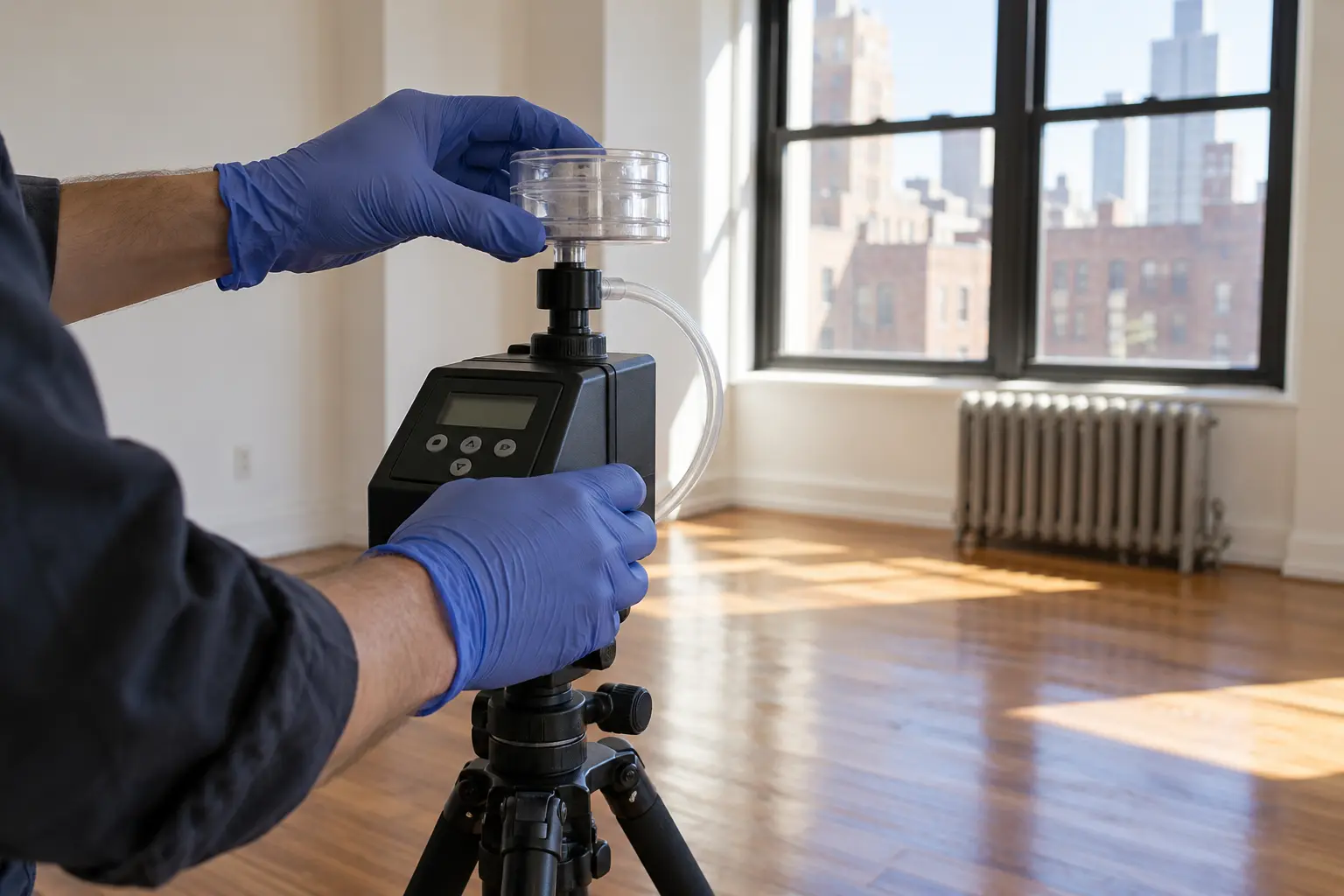
What air, surface, and bulk mold tests actually measure in NYC, what each costs, and when testing answers a question worth paying for.
Mold testing is not one procedure. It is a small set of sampling methods, each answering a narrow question, and the value of a test depends entirely on whether the question it answers is the one you actually have. A sample collected without a stated reason produces a number on a lab report and very little else.
In New York, testing also sits inside a licensing structure. Under Article 32, a licensed mold assessor is the party who collects samples, writes the assessment, and later performs post-remediation clearance, and that assessor must be independent of the company doing the removal on jobs over 10 square feet.
The Three Sampling Methods and What Each One Answers
| Method | What is collected | The question it answers |
|---|---|---|
| Air sampling | Spores drawn through a cassette over a set time | Is the airborne spore profile in this room different from outdoors or from an unaffected room? |
| Surface sampling (tape or swab) | Material lifted from a visible stain | Is this specific discoloration mold, and what genus is it? |
| Bulk sampling | A cut piece of the material itself | What is growing inside this wall cavity, insulation, or duct section? |
Air sampling is comparative by design. A single indoor reading means almost nothing on its own; it has to be read against an outdoor control taken the same day and, where possible, against a room in the same unit with no reported problem. Surface sampling confirms identity but says nothing about how much is airborne. Bulk sampling is destructive and is reserved for situations where the material has to be opened anyway.
What a Lab Report Actually Tells You
Accredited laboratories report genus, Aspergillus, Penicillium, Cladosporium, Stachybotrys and so on, along with spore counts per cubic meter for air samples. Two things are worth understanding before reading one:
- There is no legal spore-count limit in New York. No number on the report crosses a regulatory threshold. The assessor interprets the result against the outdoor control and the site conditions.
- Genus is not severity. Finding Stachybotrys on a swab confirms what is growing on that spot. It does not by itself establish how far the growth extends or what the health exposure has been.
The useful output is not the raw count. It is the assessor's written interpretation: where the moisture is coming from, how large the affected area is, and what the remediation scope should be.
Testing Versus Inspection
These are often used interchangeably and should not be. An inspection is the visual and moisture-meter survey of the property, the part that locates the water. Testing is the optional sampling layered on top of it. A competent assessor inspects first, forms a hypothesis about the source, and then samples only where a sample would confirm or rule out that hypothesis.
Our mold testing vs. inspection guide covers the distinction in more depth, and the inspection cost guide covers pricing for the survey itself.
What Testing Costs in NYC
A licensed assessment generally runs $300 to $800, with sampling typically landing within the $300-to-$600 range depending on how many samples are collected. Each sample carries a laboratory charge, so the count drives the price more than the property size does.
Ask three things before booking:
- How many samples are proposed, and what question is each one answering?
- Are laboratory fees included in the quoted price or billed separately?
- Is the written interpretation included, or only the raw lab sheet?
A quote that cannot name the reason for each sample is a quote for sample count, not for information.
When Testing Is Worth Paying For
Testing earns its cost in four situations: a musty odour with no visible source, a dispute where you need a documented record, a pre-purchase decision, and post-remediation clearance. For a visible stain under a known active leak, testing often adds a line item without changing the plan, the leak still has to be fixed and the material still has to come out.
Clearance is the exception where testing is not optional. After remediation over 10 square feet, a licensed assessor independent of the remediation company must verify the area before it is closed up. Our guide to reading clearance results walks through that report.
Home Test Kits
Retail kits use a settling plate left open in a room. Because spores are present in all indoor air everywhere, a settling plate will grow something in essentially any apartment in the city. The result is not comparative, not controlled, and not accepted as documentation in a landlord dispute or an HPD matter. See home mold test kits vs. accredited lab testing for the full comparison.
Frequently Asked Questions
Is mold testing required by law in New York?
No. Testing is not mandatory for a property owner deciding to clean up a problem. What Article 32 does require is that work over 10 square feet be preceded by a remediation protocol written by a licensed assessor, and followed by a post-remediation assessment by an assessor independent of the remediation contractor.
Can the same company test and remove the mold?
Not on jobs over 10 square feet. New York requires the assessor and the remediation contractor to be independent parties on those jobs, specifically so the company being paid to remove mold is not the one certifying that it is gone.
How long do lab results take?
Standard turnaround from an accredited laboratory is typically a few business days, with rush processing available at additional cost. Ask for the expected turnaround in writing when you book, especially if a closing date or a court date depends on it.
Does a high spore count mean my apartment is unsafe?
A spore count is a comparative measurement, not a safety rating. There is no regulatory threshold in New York that a count can exceed. What matters is how the indoor sample compares to the outdoor control taken the same day and what the assessor found physically on site.
Should I test before or after remediation?
Both serve different purposes. Testing before establishes the baseline and informs the scope. Testing after, clearance, verifies the work. On a job over 10 square feet the clearance test is required; the pre-test is a judgment call based on whether the source is already obvious.