
Mold Containment and Negative Air Explained
· NYC Mold Removal Services
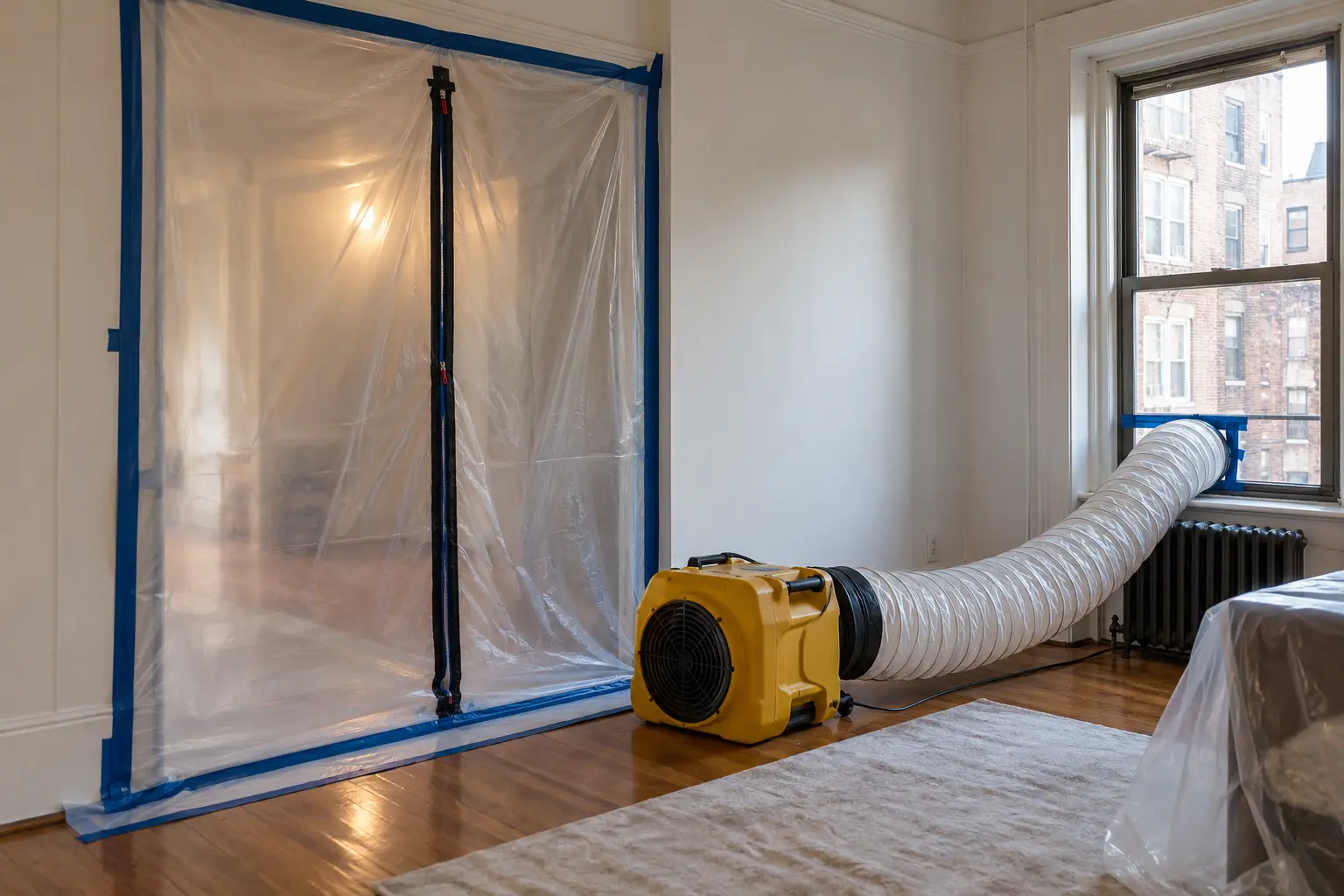
What containment barriers, HEPA filtration, and negative air pressure actually do during NYC mold remediation, and how to tell if it is set up right.
Most of the cost and most of the risk in a mold remediation job is not in the removal. It is in keeping the removal from contaminating the rest of the apartment. Cutting out wet drywall releases an enormous quantity of spores into the air; containment is the system that stops those spores from ending up in the bedroom, the HVAC system, and the hallway.
This is also the part of the work a client can actually inspect. You can walk in and see whether it was done properly.
The Three Components
| Component | What it does | What it looks like on site |
|---|---|---|
| Containment barrier | Physically separates the work area | Sealed polyethylene sheeting, taped seams, zippered entry |
| HEPA filtration | Captures spores from the air inside the barrier | Air scrubber units running continuously |
| Negative air pressure | Ensures air flows into the work area, never out | Exhaust ducted outside; sheeting visibly drawn inward |
They function as one system. A barrier without negative pressure leaks every time the entry is opened. Negative pressure without a sealed barrier simply pulls air through gaps in uncontrolled directions.
How Negative Pressure Works
An air scrubber or negative-air machine draws air out of the sealed work area, filters it through HEPA media, and exhausts it, ideally to the outside. Removing air faster than it enters makes the pressure inside the containment slightly lower than the surrounding space.
The consequence is that every unsealed gap becomes an inlet rather than an outlet. Air moves into the work area from the clean side. When someone opens the zipper, air flows inward. Contaminated air has nowhere to go but through the filter.
The visible test: sheeting under correct negative pressure is drawn inward and stays taut. Sheeting that billows outward, or hangs slack, indicates the pressure differential is not being maintained.
What HEPA Actually Means
HEPA filtration captures 99.97% of particles at 0.3 microns. That particle size matters because it is near the worst case for filter efficiency, larger and smaller particles are captured more readily, and because mould spores generally sit above it.
Two things to look for:
- HEPA vacuums, not shop vacuums. A standard shop vacuum exhausts fine particulate straight back into the room. This is one of the most common corner-cuts.
- Scrubbers running continuously, including after the cutting stops, to clear the air before containment is taken down.
HVAC Shutdown
In a NYC apartment, the single fastest way to distribute a localised problem across an entire unit, or an entire building line, is to leave the air handling running during demolition. The system should be shut down and the supply and return registers in the work area sealed before any material is disturbed.
If the growth is in the ductwork itself, that is a different and larger scope. See HVAC mold remediation in NYC.
What a Proper Setup Includes
- Sealed polyethylene barrier with taped seams at the work area perimeter
- A zippered or flap entry, not an open doorway
- For larger jobs, a decontamination chamber between the work area and clean space
- Floor protection along the entire path from the apartment door to the work area
- HVAC shut down, registers sealed
- Negative air machine exhausting outside where the building permits it
- HEPA vacuums for cleanup, not standard shop vacuums
- Sealed, labelled waste bags wiped down before leaving containment
In a building with a managing agent, the path protection and the exhaust routing often need approval in advance, that is part of why co-op and condo jobs take longer to schedule than the work itself requires.
Containment Is Not Optional on Protocol Jobs
On work over 10 square feet, the containment method is specified in the licensed assessor's remediation protocol, and the remediation contractor is working to that document. If the protocol specifies full containment with negative air and the crew arrives with a tarp and an open door, the work is not being performed to the protocol, and the independent clearance assessment at the end is the point where that tends to surface, expensively.
Our NYC mold remediation contract guide covers how containment should appear in the written scope, and reading your clearance results covers what happens at verification.
Frequently Asked Questions
What is negative air pressure in mold remediation?
It is the condition created when a HEPA-filtered machine removes air from a sealed work area faster than air enters it. The resulting lower pressure means air flows inward through any gap, so contaminated air cannot escape into clean parts of the apartment.
How can I tell if containment is set up correctly?
Look at the sheeting. Under correct negative pressure it is drawn inward and stays taut. Check that the entry is zippered rather than open, that the HVAC is off with registers sealed, that air scrubbers are running, and that the crew is using HEPA vacuums rather than shop vacuums.
Do I have to leave my apartment during remediation?
Not always. Proper containment is specifically designed to allow the rest of the unit to remain usable. Relocation depends on the size of the work area, whether essential rooms are inside containment, and whether anyone in the household is in a higher-risk group.
Should the air scrubber exhaust outside?
Exhausting outside the containment, ideally outdoors through a window, is preferred because it is what establishes the pressure differential. In buildings where outdoor exhaust is not permitted, a machine can be run in recirculating mode inside the containment, but that filters air without creating negative pressure.
Is containment required for small mold jobs?
Below 10 square feet, Article 32 does not mandate the protocol process, but disturbing any growth releases spores. Even for small work, sealing the area, shutting the HVAC, and using a HEPA vacuum meaningfully reduces how far the problem spreads.