
Mold Inspection in Manhattan: What Happens, What It Costs, and What to Ask
· Daniel Morcombe
A Manhattan mold inspection takes 1 to 2 hours and costs $300 to $800. See what a licensed inspector checks, what the report includes, and what to ask first.

A professional mold inspection usually lasts 1 to 2 hours and costs from $300 to $800; this includes a licensed visual inspection and air or surface sampling. The inspector maps the moisture, finds the source, and documents the extent in a written report. According to New York's article 32 law, the company that removes the mold on jobs over 10 square feet cannot be the same company that inspects.
What Happens During a Manhattan Mold Inspection
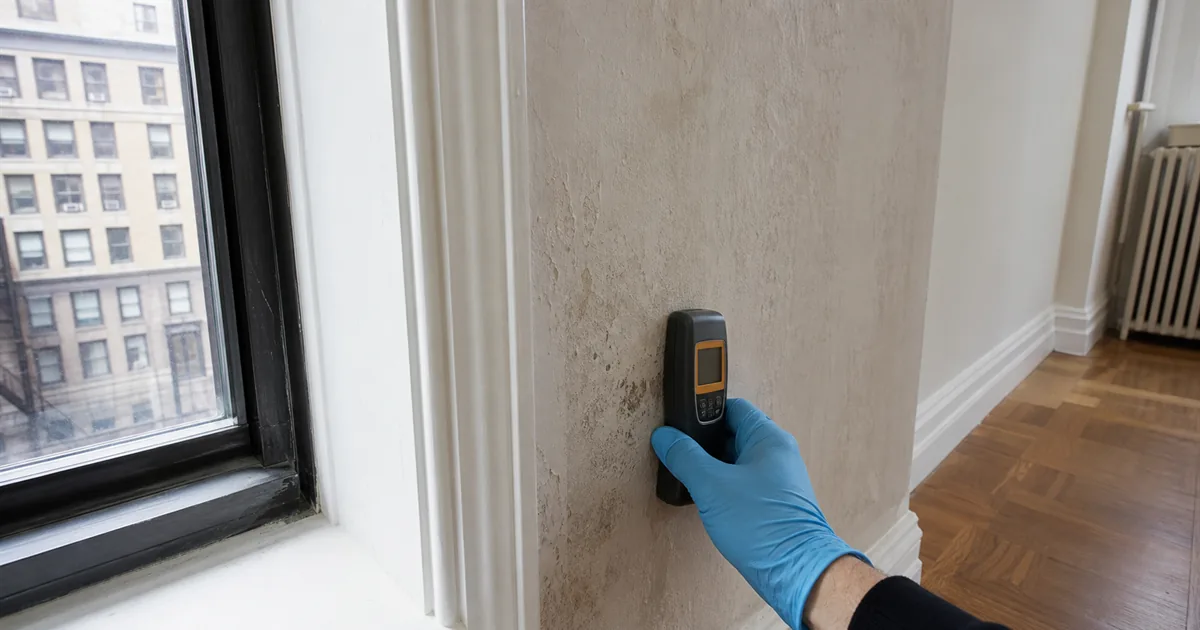
A licensed inspection isn’t a quick walk around. The assessor looks for the moisture that feeds the visible mold, because mold is a symptom and water is the cause. You'll probably get a moisture meter reading on walls and baseboards, a look at windows, radiators and pipe chases, and often a thermal camera pass to locate damp behind plaster. If sampling is required, the assessor will collect an air sample or surface swab and send the sample to an accredited lab. You receive a written report, usually a few days after, that tells you what was found, how big the area is and what work the findings require.* The target is always the water, because, as the EPA explains, controlling moisture is the key to controlling mold. For the full breakdown of each sampling method, see our mold testing guide.*
Why Manhattan Buildings Are Different
The inspection process will vary depending on the housing stock in Manhattan. The pre-war buildings have thick plaster walls that tend to hold moisture, so thermal imaging and moisture meters are more important than in new construction. In high-rise apartments, the vertical pipe risers are shared, so a leak on the second floor above your unit can show up in your unit. Most co-op and condo buildings require advance notice to management or the board before an assessor can enter common areas or open a wall. Add that lead time to your schedule. If your building was built before 1980, materials near the mold may contain asbestos, which changes the way any subsequent removal is done.
What the Inspection Report Should Contain
A useful report is specific. It should identify the location and square footage of the affected area, the suspected source of moisture, and if lab work was done, the species and spore count vs. the outdoor baseline. If the mold is greater than 10 square feet, the report is used to develop a written Remediation Protocol, which is followed by a separate licensed company. If a report says only “mold present” with no measurements, no source, it is not doing its job.
Use this as a checklist when the report lands in your inbox.
| Report element | What it must specify |
|---|---|
| Affected area | Location and square footage |
| Moisture source | The suspected source of the water |
| Lab results (if samples taken) | Species and spore count vs. the outdoor baseline |
| Mold over 10 square feet | Written Remediation Protocol for a separate licensed company |
| Not acceptable | Only "mold present," no measurements, no source |
Cost and Turnaround
Most Manhattan inspections run from $300 to $800, depending on the size of the property and the number of lab samples. A visual-only estimate for a removal quote can be free, but you pay for the lab-verified results. Laboratory turnaround time is usually 24 to 72 hours. See our mold inspection cost guide for a full price breakdown and what increases costs.
Five Questions to Ask Before You Book
- Are you a New York State Article 32 Mold Assessor? Check on the state license lookup.
- Does your report give you the square footage and the source of moisture and not just "mold present"?
- Do you remove as well? If yes, that’s a conflict of interest for jobs larger than 10 square feet.
- How long will it take to get results back and what accredited lab will be used to process the samples?
- Do you do clearance testing after it is removed by another company?
Frequently Asked Questions
How long does a mold inspection take in Manhattan?
Most residential inspections take 1 to 2 hours depending on the size of the apartment and the number of areas to be sampled. The written lab report follows 24-72 hours later. Larger units, whole-floor commercial spaces, or cases of shared risers may take longer because the assessor has to trace the moisture through more of the building.
Do I need my co-op or condo board’s permission for an inspection?
Usually not for your own apartment interior. But most co-op and condo boards require notice if the assessor needs to get into common areas, a hallway riser or open a shared wall. Contact management before you schedule so building access does not delay the visit.
Can the same company inspect and remove the mold?
Not for jobs larger than 10 sq ft. In New York, the licensed assessor and licensed remediator must be different companies, per Article 32. This protects you from a contractor who has a financial incentive to find more mold than is there.
How much does a mold inspection cost in Manhattan?
For $300 to $800 you should get a licensed inspection with lab sampling. The price increases with apartment size and the number of samples. Paid lab testing confirms species and spore levels, while Contact management before a free visual estimate is available for removal quotes.
What if the inspector finds nothing but I still smell mold?
If you can’t see any visible mold, then it’s usually behind a wall, under flooring or in the HVAC system that’s the culprit. Request thermal imaging and air sampling; Check out our hidden mold inspection page to see how the pros find hidden growth.