
How Professionals Detect Hidden Mold in Manhattan Apartments
· Daniel Morcombe
Pros locate hidden mold with thermal imaging, moisture meters, borescopes, and humidity mapping. See what each tool can and cannot reveal.
Why Sight Alone Misses Hidden Mold
Mold can grow behind drywall, under wallpaper, under flooring, or around pipes inside a wall. A completed surface may simply appear as a stain, warped paint, or even no change at all. So the assessor starts with the water history: leaks, repeated condensation, roof problems or moisture from another part of the building.
The EPA mold guidance notes that mold can be hidden behind walls, paneling, wallpaper and other finished materials. During an investigation, care must be taken because opening a contaminated area can disturb mold growth. A professional will first narrow the search and then recommend the least disruptive access that can answer the question.
Thermal Imaging: What It Shows and Misses
A thermal camera maps differences in surface temperature. A cooler area is often the result of evaporation or damp material behind the finish. A repeating line can help an assessor follow a pipe or building feature. The picture gives the inspector another thing to look at. It cannot see mold through a wall.
Temperature differences also have non-mold explanations, such as gaps in insulation or ordinary building geometry. For that reason, an assessor should never diagnose mold from a colorful thermal image by itself. The useful sequence is not anomaly, compared to water history, confirming areas with moisture readings or focused access.
Moisture Meters and Humidity Mapping
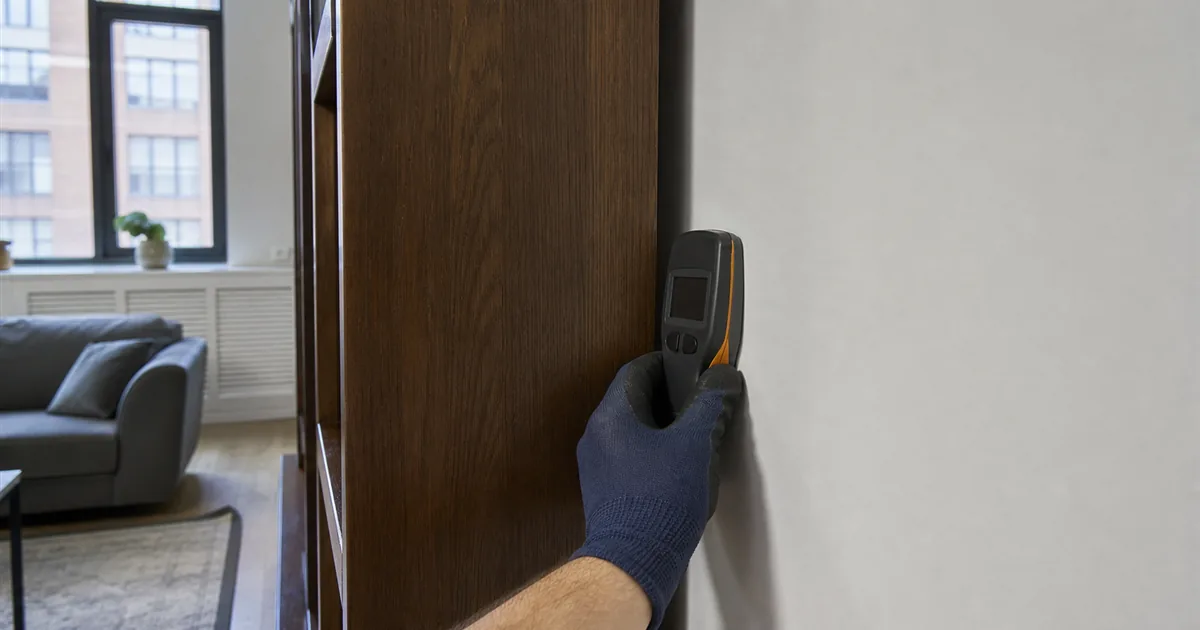
Moisture meters allow an assessor to compare suspect material with the surrounding area. If you don’t need holes in your surface, but you do need to measure it, you can use a pinless meter. You can also choose another measurement if the material or question requires it. The reading indicates the presence of moisture. It does not identify a species of mold.
Humidity mapping adds some room context. The assessor will look for relative humidity readings in different areas and note a pattern around exterior walls, bathrooms, closets or other suspect locations. One reading is just a snapshot. So factors are time, weather, ventilation and recent water use. The aim is to find where moisture is left and whether the building material needs further examination.
Borescopes for Wall Cavities
A borescope is a small camera that is inserted through a small hole to look inside a wall or a ceiling space. It can indicate a stain, wetness, damaged material or visible growth in an area the assessor can’t see from the room. If the area suspected is narrow, this can reduce unnecessary demolition.
Only that part of the cavity which is in the view of the camera is seen. Blocking, insulation, pipes, or direction of opening can leave other areas unseen. Co-op or condo management may also require notice before anyone drills or otherwise accesses a shared wall. The assessor should explain the proposed access and what can be confirmed and what is uncertain.
Detection Tools at a Glance
| Tool | What it detects | Main limitation |
|---|---|---|
| Thermal camera | Surface-temperature patterns | Shows anomalies, not mold |
| Pinless moisture meter | Relative moisture in material | Reading depends on material and context |
| Humidity meter | Relative humidity in a room | Provides a time-specific snapshot |
| Borescope | Visible conditions inside a cavity | Shows only the camera’s field of view |
Where several findings indicate the same location, the assessor may recommend focused sampling or access. Our testing guide includes sample methods.* *If the find is in a wall, the wall removal guide tells you what to do.
Frequently Asked Questions
How do you find mold behind a wall without opening it?
The assessor will narrow the search using thermal imaging, moisture readings, humidity readings and leak history. The cavity can then be examined through a small opening using a borescope. These steps will reduce unnecessary demolition, but final confirmation may still require focused access or sampling.
Does thermal imaging see mold?
Nope. The thermal camera shows differences in surface temperature, possibly related to moisture. Insulation and features of normal buildings can create similar patterns. The assessor should confirm a suspicious thermal area with moisture readings, visual evidence, or other appropriate method before arriving at a conclusion.
Can I rent mold-detection tools myself?
You can get some moisture or thermal tools, but it’s easy to misread a reading without context. If the result will be used for demolition, a property dispute or work over 10 square feet, use a licensed assessor. Check credentials with the state mold program.
Is hidden mold common in pre-war buildings?
Pre-war plaster walls and hidden building systems can conceal moisture from the room. So, hidden conditions are an important question of inspection, not a guaranteed finding. Look for a documented history of water. The age of a building is not evidence of mold. The evidence is what the assessor should follow.
What happens after an assessor finds a damp area?
The assessor determines if visual access or sampling is needed to confirm the condition and document the extent of the condition. Article 32 mandates a written protocol and licensed remediation company separately for mold exceeding 10 square feet. The moisture source needs to be fixed too.
Conclusion Detection tools are useful when they narrow the search. There is no substitute for an assessor who can relate the image or reading to the building and its water history.